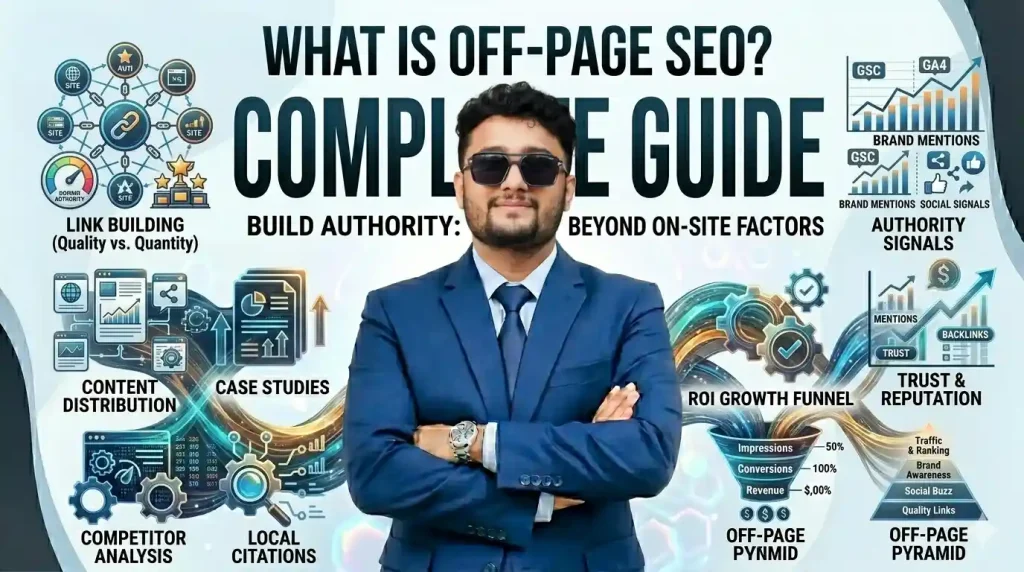
Off-page SEO is everything you do outside your website to improve your search rankings, backlinks, brand mentions, reviews, and citations that signal to Google your site is trustworthy and worth ranking. You can have perfectly optimized pages, but without these external signals, competing for valuable keywords becomes an uphill battle.
This guide covers exactly how off-page SEO works, the key factors that influence rankings, and a step-by-step process for building authority through ethical link building and brand visibility.
What is off-page SEO
Off-page SEO refers to all actions taken outside of your own website to impact your rankings within search engine results pages (SERPs). It focuses on building your site’s credibility, authority, and relevance through external signals things like backlinks, brand mentions, social media activity, and local citations.
On-page SEO deals with what’s on your site (content, HTML, structure). Off-page SEO is about how the rest of the internet perceives and references you. The most common off-page activities include:
- Backlink acquisition: Getting other websites to link to yours
- Brand mentions: Having your brand referenced across the web, even without a link
- Social media marketing: Building visibility on platforms like Facebook, LinkedIn, and X
- Local SEO and citations: Creating consistent business listings on directories like Google Business Profile
- Digital PR: Earning coverage in publications and media outlets
On-page SEO vs off-page SEO
The main difference comes down to control and location. On-page SEO happens entirely on your website, so you control every element. Off-page SEO happens elsewhere, which means you have limited control over how others link to or mention you.
| Factor | On-Page SEO | Off-Page SEO |
| Control | Full control | Limited control |
| Focus | Content, HTML, site structure | External reputation and trust |
| Examples | Keywords, meta tags, internal links | Backlinks, brand mentions, reviews |
| Where it happens | On your website | Outside your website |
These two core types of SEO work together. You can have perfectly optimized pages, but without external signals proving your authority, ranking for competitive keywords becomes difficult.
Why off-page SEO matters for rankings
Search engines use off-page signals to evaluate whether your website deserves to rank. External signals act as third-party validation proof that real people and real websites find your content valuable.
Links and mentions influence search results
Backlinks function as votes of confidence. When a reputable site links to you, it tells Google your content is worth referencing. Even unlinked brand mentions where someone talks about your business without linking can signal trust and relevance to search engines.
Off-page SEO builds domain authority
Domain authority is a metric that measures the overall strength of your website. High-quality backlinks from relevant, authoritative sites are the primary driver of domain authority growth. The more trusted sites that reference you, the more Google trusts you.
Off-page signals support E-E-A-T
E-E-A-T stands for Experience, Expertise, Authoritativeness, and Trustworthiness key components of Google’s quality guidelines. External signals like mentions in authoritative publications, positive reviews, and links from expert sources all demonstrate E-E-A-T to search engines.
Key off-page SEO factors that affect rankings
Several external factors influence how search engines evaluate your site’s authority and trustworthiness.
Backlinks and link quality
Not all links carry equal weight. The most impactful backlinks come from sites that are relevant to your industry and have high authority themselves.
A few things matter here:
- Anchor text: The clickable words in a hyperlink affect how search engines interpret the link
- Dofollow vs nofollow: Dofollow links pass authority, while nofollow links typically don’t (though they can still drive traffic)
- Relevance: A link from a site in your industry carries more weight than one from an unrelated site
Brand mentions and citations
Citations are mentions of your business name, address, and phone number (NAP) on other websites, especially directories. Consistent citations across the web reinforce your business identity and build trust signals that search engines recognize.
Social signals
Social media engagement isn’t a direct ranking factor, but it serves as an indirect signal. Strong social activity drives traffic, increases visibility, and often leads to more backlinks and brand mentions over time.
Online reviews and trust signals
Reviews on Google, industry directories, and third-party platforms heavily influence user perception and local rankings. For businesses targeting local customers, positive reviews can directly impact whether you appear in the local map pack.
How to do off-page SEO optimization step by step
Here’s a practical implementation process you can follow, even if you’re just getting started with off-page optimization.
1. Audit your current backlink profile
Run a backlink audit using tools like Google Search Console, Ahrefs, or SEMrush to check your existing backlinks. Look at the quality of referring domains, identify any toxic or spammy links, and review your anchor text distribution. This baseline helps you understand where you’re starting from.
2. Analyze competitor backlinks
Study where your competitors get their links. SEO tools can identify high-quality sites linking to competitors but not to you and those become your outreach targets. If a site linked to similar content before, they might link to yours too.
3. Create linkable content assets
Linkable assets are pieces of content so valuable that others naturally want to reference them. Examples include:
- Original research or surveys
- Comprehensive guides
- Infographics
- Free tools or calculators
- Unique data studies
Without something worth linking to, outreach becomes much harder.
4. Build links through guest posting
Guest posting means writing articles for other websites in your niche. In return, you typically get an author bio with a backlink. Focus on sites with real, engaged audiences rather than sites that exist purely for link exchanges.
5. Use digital PR for brand mentions
Digital PR involves pitching stories, data, or expert commentary to journalists and publications. Platforms like HARO (Help a Reporter Out) connect you with journalists seeking sources, which can lead to high-authority backlinks and brand mentions.
6. Reclaim unlinked brand mentions
Set up Google Alerts to find mentions of your brand that don’t include a link. When you find one, reach out politely and ask if they’d be willing to add a link. Since they already mentioned you, the conversion rate on these requests tends to be higher than cold outreach.
7. Try broken link building
Find dead (404) links on other websites using tools like Ahrefs or Check My Links. Contact the site owner, let them know about the broken link, and suggest your relevant content as a replacement. You’re helping them fix a problem while earning a link.
8. Build local citations and reviews
For local businesses, submit your information to relevant directories and ensure your NAP is consistent everywhere. Encourage satisfied customers to leave Google reviews this directly impacts local pack visibility.
Off-page SEO strategies for local businesses
Local businesses require specific off-page techniques to rank in Google Maps and local search results. Unlike national or global SEO campaigns, local off-page optimization focuses heavily on geographic relevance and community trust signals. The strategies below target the specific ranking factors that influence local pack visibility and help customers in your area find your business.
Optimize your Google Business Profile
Claim and verify your Google Business Profile, then complete every section categories, services, photos, posts, and business hours. Respond to all reviews, both positive and negative. An active, complete profile signals legitimacy to Google.
Build local citations with NAP consistency
Your business name, address, and phone number need to be identical across all directories. Inconsistencies confuse search engines and can hurt your local rankings. Check major directories like Yelp, Yellow Pages, and industry-specific listings.
Generate and manage online reviews
Create a simple system for requesting reviews from satisfied customers. Make it easy by sending a direct link to your Google review page. Respond professionally to every review to show you value customer feedback.
Tip: A steady flow of recent reviews matters more than a large number of old reviews. Aim for consistency rather than one-time review campaigns.
How to track and measure off-page SEO results
Off-page SEO takes time, often 3-6 months, before you see significant ranking changes. Tracking your efforts helps you understand what’s working.
Monitor backlinks in Google Search Console
The “Links” report shows which websites link to you, which pages receive the most links, and what anchor text is being used. Check this monthly to spot new links and identify any suspicious patterns.
Track domain authority and referring domains
Use Moz, Ahrefs, or SEMrush to monitor your domain authority score over time. Pay attention to the number of unique referring domains a growing number indicates a broadening, healthier link profile.
Set up alerts for brand mentions
Google Alerts is free and tracks whenever your brand appears online. This helps you find unlinked mentions, monitor PR coverage, and keep tabs on your online reputation.
Best off-page SEO tools
Here are the tools that make executing and tracking off-page campaigns significantly easier:
- Ahrefs: Excellent for backlink analysis, competitor research, and link prospecting through Content Explorer
- SEMrush: Offers backlink audits, link-building outreach tools, and brand monitoring
- Moz Link Explorer: Known for Domain Authority metrics and spam score analysis
- Google Search Console: Free tool showing who links to your site and how Google views your backlink profile
- Google Alerts: Free monitoring for brand mentions, competitor activity, and industry keywords
Common off-page SEO mistakes to avoid
Here are the errors that can hurt your rankings or waste your time entirely.
Buying links or using link schemes
Buying links violates Google’s guidelines and can result in manual penalties. Avoid PBNs (private blog networks), paid link schemes, and any tactic that feels manipulative. The short-term gains aren’t worth the long-term risk.
Prioritizing quantity over link quality
One high-quality backlink from a relevant, authoritative site outweighs dozens of low-quality links yet this remains one of the most persistent SEO myths. Chasing volume often leads to spammy links that hurt rather than help.
Neglecting toxic backlink cleanup
Spammy or manipulative backlinks can harm your rankings. Audit your profile regularly and use Google Search Console’s disavow tool to tell Google to ignore harmful links.
Ignoring local citations and reviews
For businesses with physical locations, inconsistent NAP data and missing reviews are common oversights that severely hurt local rankings.
Expecting results too quickly
Off-page SEO is a long-term strategy. Building authority happens gradually over months, not days. Patience and consistency matter more than aggressive short-term tactics.
Off-page SEO tips for beginners
If you’re just starting out, focus on a few fundamentals:
- Start with one linkable asset: Create one truly valuable piece of content before launching wide-scale outreach
- Focus on relevance over volume: A link from a small but highly relevant industry blog often outweighs a link from a large, unrelated site
- Build relationships first: Engage with site owners before pitching comment on their posts, share their content, provide value
- Stay consistent: Set a regular schedule for content promotion and outreach; results compound over time
Build your off-page authority with a proven offsite SEO strategy
Off-page SEO builds the trust and authority your website needs to rank by leveraging external signals like backlinks, brand mentions, and online reviews. An ethical, relevance-driven approach is the key to sustainable, long-term results.
The process takes time and consistent effort, but the payoff higher rankings, more organic traffic, and stronger brand recognition makes it worthwhile.
FAQs about off-page SEO
How long does off-page SEO take to show results?
Off-page SEO typically takes 3-6 months to impact rankings because search engines need time to discover, crawl, and evaluate new backlinks and mentions. Competitive keywords may take longer.
Can off-page SEO work without link building?
While backlinks remain the strongest off-page signal, brand mentions, reviews, and social engagement also contribute. However, links typically have the biggest impact on rankings.
Is off-page SEO more important than on-page SEO?
Both are essential. On-page SEO helps search engines understand your content, while off-page SEO proves your site is trustworthy and authoritative. You need both for strong rankings.
How many backlinks does a website need to rank?
There’s no fixed number. What matters is the quality, relevance, and authority of linking sites rather than total count. One strong link can outweigh dozens of weak ones.
Does social media activity directly improve SEO rankings?
Social signals aren’t a direct ranking factor, but social media increases content visibility, drives traffic, and can lead to more backlinks and brand mentions that do affect rankings.
What is the safest way to build backlinks for off-page SEO?
The safest approach is earning links through valuable content, genuine outreach, and digital PR rather than buying links or using automated schemes that violate search engine guidelines.