Most business owners struggle to rank because they treat SEO as a single, isolated task rather than a synchronized machine. You might have optimized your keywords but neglected your site speed, or built a beautiful blog that search engines cannot actually find or crawl. This gap exists because modern search success requires a holistic approach where multiple technical and creative strategies work in total harmony.
In this guide, you will discover the specific pillars that form a complete SEO framework. You will walk away with a clear roadmap of how Technical, On-Page, Off-Page, and Local SEO combine to turn a standard website into a high-ranking authority.
What Are the Different Types of SEO?
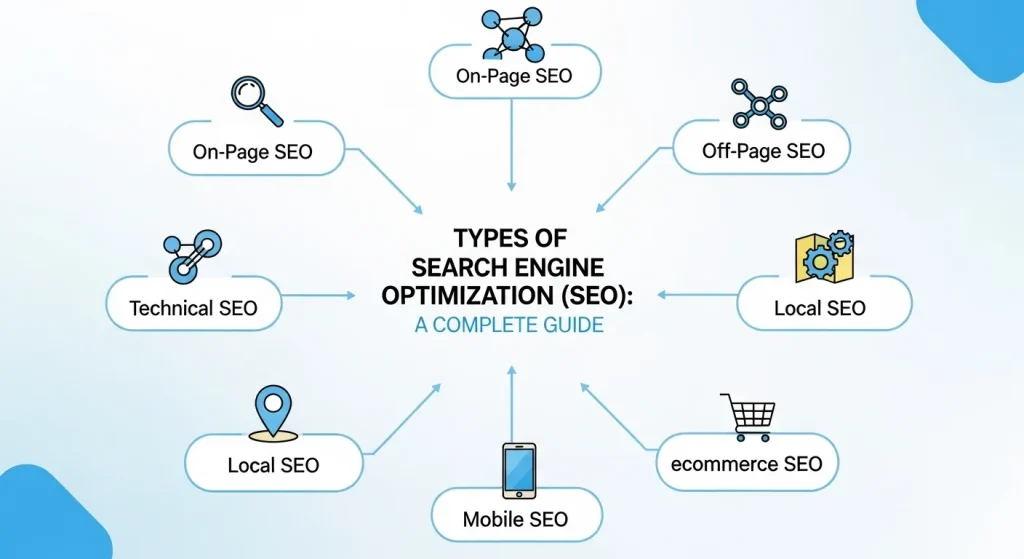
The different types of SEO represent specialized categories of optimization that improve a website’s performance, relevance, and authority in search engine results. Search engine optimization is divided into four main pillars: Technical SEO, On-page SEO, Off-page SEO, and Specialized strategies (like Local or E-commerce SEO). In 2026, search engines evaluate how these different layers work together to provide a fast, safe, and helpful experience for the user.
1. On-Page SEO
On-page SEO is the process of optimizing individual elements within a website to help search engines understand the content and its relevance to user queries. This type of optimization involves making changes directly to the visible content and the underlying HTML code that you can control. (On-Page Factors) -> (Communicate) -> (Content Context). By perfecting these elements, you ensure that both humans and search bots can navigate and interpret your information efficiently.
Key Elements of On-Page SEO:
- Keyword Optimization: You must identify and place high-value search terms naturally within your text to match user intent.
- Title Tags & Meta Descriptions: These snippets serve as the “digital headline” and summary that appear in search results to attract clicks.
- Header Tags (H1, H2, H3): Using headers organizes your content into a logical hierarchy, making it easier for Google to index specific sections.
- Internal Linking: You should link to other relevant pages on your own website to help distribute authority and guide users.
- Image Optimization: Every image requires descriptive “alt-text” and a small file size to help Google understand the visual and keep the page fast.
- URL Structure: Clean, keyword-rich URLs provide a clear path for both search engines and users to follow.
- Content Quality: You must produce unique, helpful, and accurate information that fully answers the searcher’s question.
On-page SEO matters because it is the primary signal Google uses to determine if a specific page is a good match for a search query. Without these signals, even the most well-written article remains invisible because the search engine cannot connect the content to the right keywords. (Optimized Pages) -> (Improve) -> (Keyword Rankings). It directly impacts your “Relevance Score,” which is the foundation of where your site appears in the search results.
Case Study Scenario: A boutique travel blog in Nepal updated its old articles by fixing the H1 tags and adding internal links to newer posts. Within 30 days, their organic traffic increased by 25% because Google finally understood how their different articles were related to each other.
2. Off-Page SEO
Off-page SEO refers to the strategic actions taken outside of your own website to impact your rankings within search engine results pages. Unlike on-page SEO which focuses on your content, off-page SEO is centered on building your website’s reputation and trustworthiness through external validation. (External Signals) -> (Validate) -> (Site Trustworthiness). It acts as a set of “digital recommendations” that tell search engines your brand is a leader in its field.
Key Elements of Off-Page SEO:
- Link Building: You must acquire high-quality hyperlinks from other reputable websites to act as “votes of confidence” for your content.
- Guest Posting: Writing valuable articles for other industry blogs allows you to reach new audiences and earn authoritative backlinks.
- Social Signals: High engagement and sharing of your content on social media platforms indirectly indicate to Google that your brand is popular and relevant.
- Brand Mentions: Even without a clickable link, when other websites or news outlets mention your brand name, it strengthens your overall search presence.
- Influencer Outreach: Partnering with industry leaders to promote your content helps you gain instant credibility and high-value traffic from their loyal followers.
Off-page SEO is important for authority because search engines use these external signals as tie-breakers between websites that have similar on-page quality. While your content says you are an expert, your off-page profile proves that other experts agree with you. (High-Quality Backlinks) -> (Increase) -> (Domain Authority). Without a strong off-page strategy, a technically perfect website may struggle to outrank older, more established competitors.
Case Study Scenario: A new financial consulting firm in Nepal created the best guides on tax laws but couldn’t reach the first page. After they were featured in a major national news interview (Brand Mention) and received links from local business directories (Link Building), their authority score tripled. Within two months, they secured the top spot for competitive search terms because Google finally viewed them as a trusted local leader.
3. Technical SEO
Technical SEO is the practice of optimizing a website’s infrastructure to ensure search engines can successfully crawl, index, and render its pages. It functions as the “engine” of your website, focusing on backend elements that improve the site’s visibility and functionality without directly involving the content itself. (Technical Structure) -> (Supports) -> (Search Accessibility).
Core Technical SEO Factors:
- Website Speed: You must minimize page load times to prevent users from leaving and to satisfy Google’s speed requirements.
- Mobile-Friendliness: Your site must use responsive design to provide a seamless experience for visitors on smartphones and tablets.
- XML Sitemaps: This file acts as a roadmap for search engines, listing all your important pages so they can be discovered easily.
- Robots.txt: This text file tells search engine bots which parts of your site they are allowed to visit and which they should ignore.
- HTTPS Security: Implementing an SSL certificate encrypts data and serves as a minor ranking signal that builds user trust.
- Structured Data (Schema): Adding specific code to your HTML helps search engines understand the context of your data, such as product prices or review ratings.
- Fixing Crawl Errors: You must regularly find and repair broken links (404 errors) and redirect loops to keep the search engine’s path clear.
Technical SEO impacts rankings by determining whether your website is eligible to appear in search results at all. If search engine bots encounter technical barriers, they cannot reach your high-quality content, making your other SEO efforts useless. (Technical Health) -> (Enables) -> (Search Visibility). In 2026, a technically sound website is a requirement for ranking, as search engines prioritize sites that offer a fast, secure, and error-free experience.
Case Study Scenario: A local news site in Nepal had thousands of high-quality articles but saw a 50% drop in traffic. After a technical audit, they discovered a mistake in their Robots.txt file that was blocking Google from seeing their latest stories. Once they fixed the file and updated their XML Sitemap, their traffic recovered within a week because Google could finally index their work again.
4. Local SEO
Local SEO is the process of optimizing a website and online presence to increase visibility in location-based search results. This strategy focuses on reaching customers in a specific geographic area, such as a city or neighborhood, particularly for “near me” searches. (Local Presence) -> (Drives) -> (Physical Foot traffic). It ensures that when someone searches for a service in their immediate vicinity, your business appears at the top of the map and search listings.
Key Local SEO Strategies:
- Google Business Profile Optimization: You must claim and verify your profile, ensuring your hours, services, and photos are completely up to date.
- Local Keywords: You should include city or neighborhood names within your content and meta tags to signal your location to search engines.
- NAP Consistency: You must ensure your business Name, Address, and Phone number are identical across every website and directory on the internet.
- Local Citations: Listing your business in local directories like Yellow Pages or industry-specific sites helps build geographic authority.
- Reviews Management: You should actively encourage and respond to customer reviews to build trust and improve your ranking in the local map pack.
Local SEO is essential for any business that operates out of a physical location or serves a specific geographic region. This includes service providers like plumbers and lawyers, as well as retail shops, restaurants, and medical clinics. (Geographic Relevance) -> (Connects) -> (Local Consumers). Without a strong local strategy, you risk losing nearby customers to competitors who have optimized their map presence and local reputation.
Case Study Scenario: A dental clinic in Lalitpur was struggling to get new patients despite having a modern office. By optimizing their Google Business Profile and ensuring their NAP consistency across local health directories, they started appearing in the “Map Pack” for the keyword “dentist near me.” Within three months, they saw a 60% increase in appointment bookings from local residents who found them directly through Google Maps.
5. E-Commerce SEO
E-commerce SEO is a specialized strategy designed to improve the visibility of online stores and drive direct sales through organic search. Unlike standard blogs, e-commerce optimization must handle thousands of product pages and complex site structures while moving users from “browsing” to “buying.” (Product Visibility) -> (Increases) -> (Conversion Rates).
What Makes E-Commerce SEO Different:
- Product Page Optimization: You must write unique descriptions and optimize images for every item to avoid duplicate content penalties.
- Category Structure: Organizing products into logical hierarchies helps search engines understand your inventory and improves user navigation.
- Schema Markup for Products: Adding structured data allows Google to show prices, stock status, and star ratings directly in search results.
- User-Generated Reviews: Encouraging customer feedback provides “fresh” content for your pages and builds high levels of social proof.
- Faceted Navigation Control: You must manage filters (like size or color) so that thousands of similar URLs do not confuse search engine crawlers.
Case Study Scenario: A local online clothing store in Nepal noticed their products weren’t appearing in Google Images. After adding Schema Markup and optimizing their Product Page titles, their click-through rate from search results increased by 35%, as customers could now see prices and ratings before even visiting the site.
6. Mobile SEO
Mobile SEO is the process of ensuring that your website looks and functions perfectly for users visiting from smartphones and tablets. Since Google now uses Mobile-first indexing, the mobile version of your site is the primary version used to determine your rankings. (Mobile Experience) -> (Determines) -> (Search Authority).
Key Factors of Mobile SEO:
- Responsive Design: Your website layout must automatically adjust to fit any screen size, providing a seamless experience across all devices.
- Mobile Page Speed: You must optimize for fast loading on mobile networks, as mobile users are more likely to leave if a site takes too long to load.
- Core Web Vitals: You must monitor specific metrics like loading performance and visual stability to meet Google’s “Page Experience” standards.
- Avoiding Intrusive Pop-ups: You should avoid using large banners that cover content on small screens, as this can lead to search penalties.
Case Study Scenario: A news portal realized that 80% of their readers were using mobile phones, but their “Bounce Rate” was very high. After switching to a Responsive Design and improving their Core Web Vitals, they saw a 40% increase in the time users spent reading their articles on mobile devices.
7. Content SEO
Content SEO is the practice of creating and optimizing high-quality information that answers user questions and satisfies search engine algorithms. It focuses on the strategy behind your writing to ensure that your pages are not just well-written, but also highly “discoverable.” (Strategic Content) -> (Achieves) -> (Topic Authority).
Core Strategies of Content SEO:
- Keyword Research Strategy: You must identify the specific terms and phrases your audience is searching for before you begin writing.
- Content Clustering: You should group related articles around a “Pillar Page” to show Google that you are an expert on a specific subject.
- Search Intent Optimization: You must ensure your content matches what the user actually wants, whether they are looking for information or a product to buy.
- Content Freshness: Regularly updating your old articles with new data and insights helps maintain your rankings over time.
- Long-form vs. Short-form Content: You must choose the right length for your content; deep topics need 2,000+ words, while quick answers only need a few paragraphs.
Case Study Scenario: A digital marketing agency started a Content Clustering strategy by writing ten small articles about different types of SEO and linking them all to one master guide. This helped the master guide rank #1 for “SEO in Nepal” because Google recognized the agency as a broad authority on the entire topic.
Comparison Table: White Hat vs. Black Hat SEO
| Feature | White Hat SEO (Ethical) | Black Hat SEO (Risky) |
| Primary Goal | Follows search engine guidelines to help users. | Manipulates algorithms to gain quick rankings. |
| Tactics Used | Quality content, mobile optimization, earned links. | Keyword stuffing, cloaking, and spam links. |
| Risk Level | Low; safe from algorithm penalties. | High; high chance of being banned by Google. |
| Time to Results | Slow and steady growth. | Fast but temporary spikes. |
| Sustainability | Builds long-term business value. | Often leads to permanent site de-indexing. |
Which Type of SEO Is Most Important?
No single type of SEO is more important than the others because they function as a connected ecosystem where the failure of one part weakens the entire strategy. You cannot rank high with great content if your website is too slow to load, and you cannot stay at the top if no other websites trust or link to you. A successful website requires all layers to work together to satisfy both search engine algorithms and human visitors.
Conclusion
SEO consists of multiple strategies that complement each other to create a strong and visible online presence. Success on Google requires a holistic approach where the technical health of your site supports the high-quality content you create. By treating these different categories as a unified team, you ensure that your website remains competitive even as search algorithms evolve in 2026.
Businesses should combine on-page, off-page, and technical SEO to build long-term authority and trust. If you focus only on one area, such as keywords, while ignoring site speed or backlinks, your rankings will eventually hit a ceiling. A complete strategy covers every touchpoint of the user journey, from the initial search to the final click on your website.
Choosing the right SEO mix depends on your specific business goals and the industry you operate in. Your next step should be to audit your current website to see which of these pillars needs the most attention today. Are you ready to grow your website traffic? Contact Gemini today to build a custom SEO strategy that puts your business on the first page of Google.
Frequently Asked Questions
1. What are the main types of SEO?
The main types of SEO are technical, on-page, and off-page SEO. These three pillars work together to improve a website’s speed, content relevance, and overall authority.
2. How many types of SEO are there?
There are generally four primary types, including technical, on-page, off-page, and local SEO. Specialized fields like E-commerce, Mobile, and Content SEO also fall under these broader categories.
3. Is technical SEO more important than on-page SEO?
Neither is more important because a website needs both a healthy technical foundation and high-quality content to rank. If your site has technical errors, Google will not be able to find or rank your excellent on-page content.
4. What is the difference between local SEO and traditional SEO?
Local SEO focuses specifically on appearing in location-based searches like “near me” or specific city results. Traditional SEO aims to rank for broader keywords regardless of the searcher’s physical location.
5. Can I do all types of SEO myself?
Yes, an individual can learn and perform every type of SEO using free online resources and tools. However, managing all pillars for a large website often requires a dedicated team or specialized agency.
6. What type of SEO is best for beginners?
On-page SEO is typically the best starting point because it is easy to understand and yields visible results quickly. Beginners can start by optimizing titles, headings, and keyword placement within their articles.
7. How long does SEO take to show results?
Most websites begin to see significant ranking improvements within three to six months of consistent optimization. This timeline depends on the competition of the keywords and the current health of the website.
8. Is link building part of off-page SEO?
Yes, link building is the most critical element of off-page SEO because it builds your site’s reputation. Getting links from trusted websites acts as a vote of confidence that boosts your authority in Google’s eyes.
9. What is the role of Content SEO in a digital strategy?
Content SEO focuses specifically on creating and structuring information to match user search intent. It ensures that every blog post or page provides the exact value that a searcher is looking for.