Most business owners launch a website only to find it sits in a digital desert with zero visitors. You invest time and money into a beautiful design, yet the daily traffic report remains at zero because your target customers cannot find you among millions of competing pages. This lack of visibility is the primary reason why many online ventures fail before they even start.
This guide eliminates the mystery of Search Engine Optimization (SEO) by providing a clear, step-by-step roadmap for beginners. You will learn how to align your content with Google’s algorithms, identify the specific keywords your audience uses, and build a sustainable stream of free, organic traffic. By the end of this blog, you will have a functional strategy to move your site from the back pages of search results to the front row.
What is SEO in Simple Terms?
Search Engine Optimization (SEO) is the process of improving your website to increase its visibility when people search for products or services related to your business in Google, Bing, and other search engines. By optimizing your site, you ensure that search algorithms recognize your content as the most relevant and authoritative answer to a user’s specific query.
Search engines use automated bots called crawlers to scan the internet, index every page they find, and store them in a massive digital library. When a user enters a search term, the algorithm analyzes thousands of indexed pages to determine which ones provide the best value based on relevance, site speed, and credible links.
The primary difference between organic SEO and paid search ads is the cost and longevity of the results. Organic SEO focuses on earning a top spot through content quality and technical health, providing long-term traffic without a direct cost per click. Paid ads, or Pay-Per-Click (PPC), allow you to buy your way to the top of the results instantly, but your traffic stops the moment you stop paying for the advertisements.
Why is SEO Important for Your Business?
SEO is the most effective way to reach customers who are actively searching for the specific solutions, products, or services your business provides. Unlike traditional marketing that pushes messages toward an uninterested audience, search optimization captures “inbound” interest, meaning you connect with users at the exact moment they need your help.
Securing higher organic rankings builds significantly more trust and authority with your audience than paid advertisements. Most users instinctively skip over the “Sponsored” tags at the top of the page because they value Google’s editorial judgment; appearing in the top organic results signals that your business is a credible leader in your industry.
Furthermore, SEO provides sustainable, long-term results that far outlast the temporary visibility of social media posts or paid campaigns. While a social media update disappears from a user’s feed within hours, a well-optimized blog post can continue to rank and generate new leads for years after you hit the publish button. This makes search engine optimization one of the highest-return investments a modern business can make.
The Role of Keywords in SEO
Keywords are the specific words and phrases that users type into search engines to find information, products, or services. They act as the primary communication bridge between a user’s problem and your website’s solution, telling search engine algorithms exactly what your content is about.
1. Keyword Research and Selection
Keyword research is the process of identifying the terms your target audience uses and selecting low-competition phrases to achieve faster rankings. Instead of targeting broad, highly competitive terms, successful beginners focus on “long-tail keywords” which are more specific and easier to rank for on Google.
2. Matching Search Intent
Search intent is the underlying reason why a user performs a search, and your content must satisfy that specific goal to rank well. If a user searches for a “how-to” guide but lands on a product sales page, they will leave immediately, signaling to Google that your page is not a helpful result.
3. Strategic Keyword Placement
Effective keyword placement involves naturally integrating your primary search terms into high-impact areas of your page to signal relevance to crawlers. You must include your main keyword in the Title Tag (H1), at least one subheadline (H2), and within the first 100 words of your introduction to ensure maximum visibility.
Key Types of SEO You Need to Know
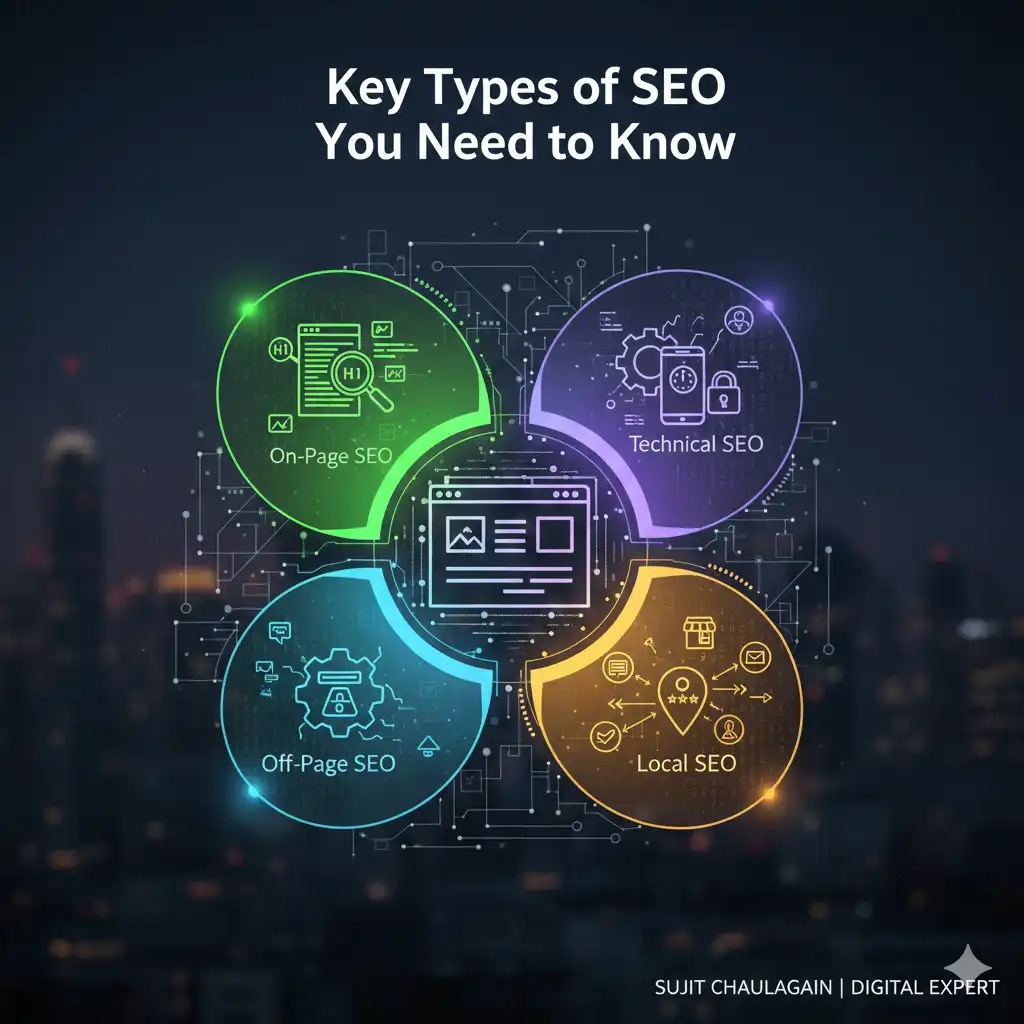
To rank effectively on Google, you must address different facets of your website’s performance and reputation. SEO is not a single task but a combination of four distinct categories that work together to prove your site’s value to search engines.
1. On-Page SEO: Optimizing Content and Structure
On-page SEO refers to the practice of optimizing individual web pages to rank higher and earn more relevant traffic. This involves fine-tuning both the visible content and the HTML source code to make it as clear as possible for search engine crawlers.
- Content Quality: Writing informative, original text that fully answers the user’s question.
- Headings: Using H1, H2, and H3 tags to create a logical hierarchy for your information.
- Image Alt Text: Adding descriptive text to images so search engines can understand the visual elements.
- Internal Linking: Connecting your blog posts to other relevant pages on your own site.
2. Technical SEO: Enhancing Site Infrastructure
Technical SEO focuses on the backend of your website to help search engines crawl and index your pages more efficiently. If your site has technical flaws, even the best content in the world will struggle to rank because search engines cannot access it properly.
- Site Speed: Ensuring your pages load in under three seconds to prevent users from bouncing.
- Mobile-Friendliness: Optimizing your design to work perfectly on smartphones and tablets.
- Secure Connection (HTTPS): Protecting user data with an SSL certificate, which is a confirmed ranking factor.
3. Off-Page SEO: Building Authority and Reputation
Off-page SEO involves actions taken outside of your own website to impact your rankings within search engine results pages. The primary goal is to build the “authority” of your domain so that Google views your site as a trusted source of information.
- Backlinks: Earning links from other reputable websites, which act as “votes of confidence” for your content.
- Social Signals: Generating engagement and shares across social media platforms.
- Guest Posting: Contributing high-quality articles to other sites in your industry to reach a wider audience.
4. Local SEO: Targeting Geographical Searches
Local SEO is a specialized strategy used to increase your visibility for searches with a specific geographical intent, such as “coffee shop near me.” This is essential for brick-and-mortar businesses or service providers that operate in specific cities or regions.
- Google Business Profile: Claiming and optimizing your profile to appear in the “Map Pack” results.
- Local Citations: Ensuring your business name, address, and phone number (NAP) are consistent across all online directories.
- Customer Reviews: Encouraging satisfied local customers to leave positive feedback to boost local trust.
Common SEO Mistakes to Avoid
Even with a solid strategy, certain “black hat” or outdated practices can lead to search engine penalties or poor user engagement. Avoiding these common pitfalls is essential to maintaining long-term rankings and building a credible online presence.
1. Keyword Stuffing: Quantity Over Quality
Keyword stuffing is the practice of loading a webpage with keywords or numbers in an attempt to manipulate search rankings. This often results in a poor user experience and can lead to Google penalizing your site, as modern algorithms are designed to reward natural, human-centric writing rather than repetitive phrases.
2. Writing for Bots Instead of Humans
A common error is focusing so much on technical optimization that the content becomes robotic and difficult to read. If your visitors find the content unhelpful or confusing, they will leave your site quickly, which increases your bounce rate and tells search engines that your page is not a high-quality result.
3. Ignoring Technical Performance and Mobile Users
Failing to optimize for mobile devices or ignoring slow page load speeds is a critical mistake in a “mobile-first” indexing world. Since a majority of global searches now happen on smartphones, a site that is difficult to navigate on a small screen will be de-prioritized by search engines, regardless of how good the content is.
4. Expecting Instant Success
SEO is a long-term marketing strategy, and expecting to reach page one of Google overnight is unrealistic and often leads to frustration. Building authority and trust with search engines takes consistent effort over months; businesses that look for “shortcuts” or “hacks” usually end up with temporary gains followed by permanent ranking drops.
How to Measure Your SEO Success
You can measure SEO success by tracking how well your website attracts, engages, and converts visitors coming from search engines. Unlike paid advertising, SEO success is measured by the growth of organic visibility and the quality of the interactions users have with your content over time.
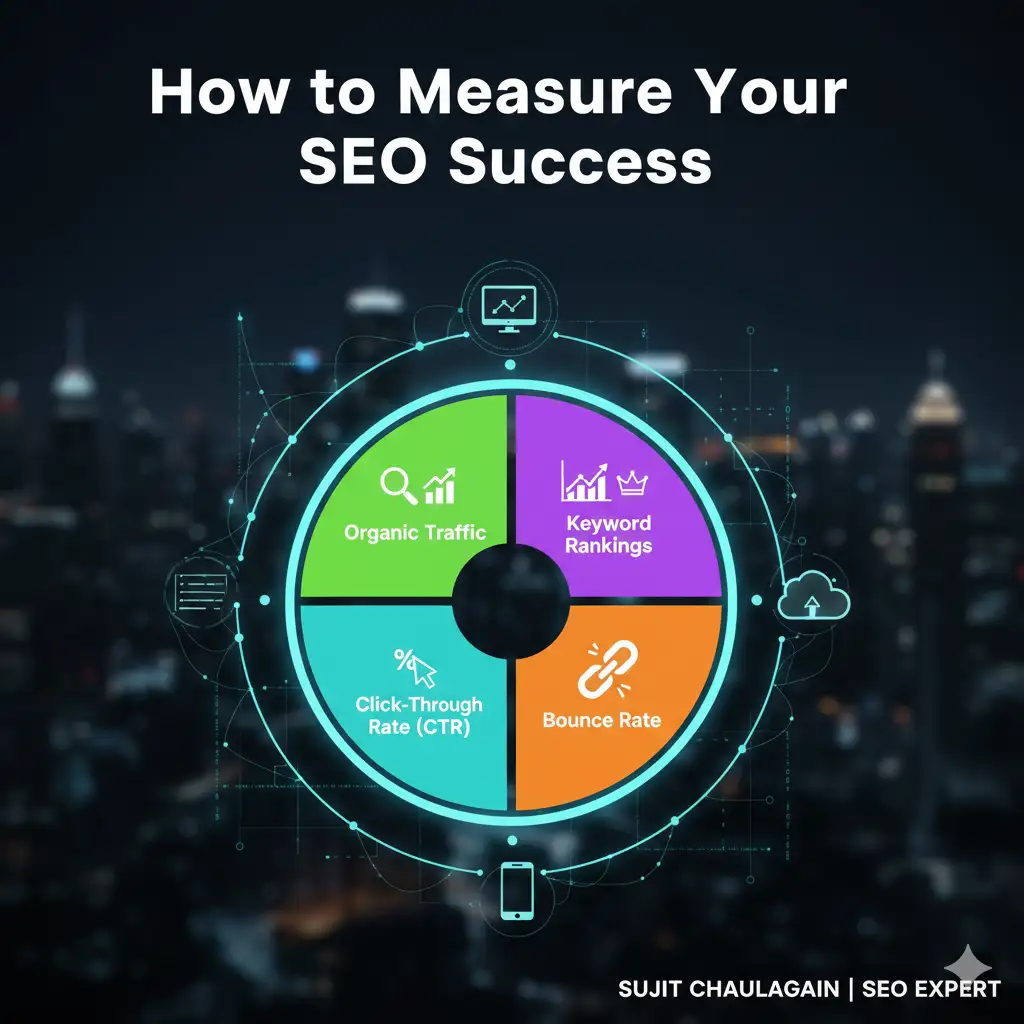
Successful tracking requires a combination of tools that monitor both where you rank and how users behave once they land on your site. By analyzing these data points, you can refine your strategy to focus on the keywords and pages that drive the most value for your business.
1. Tracking Organic Traffic in Google Analytics
Organic traffic growth is the most important indicator that your SEO strategy is working effectively. Google Analytics allows you to isolate traffic from search engines to see if your visitor count is increasing month-over-month without the help of paid ads.
2. Checking Keyword Rankings in Google Search Console
Google Search Console provides a direct look at which specific search terms are bringing people to your website. This tool helps you identify your average position for target keywords and shows you “impressions,” which is how many times your site appeared in search results even if the user didn’t click.
3. Monitoring Click-Through Rate (CTR) and Bounce Rate
Click-Through Rate (CTR) measures the effectiveness of your titles and meta descriptions in convincing users to click your link. Meanwhile, the Bounce Rate tells you if your content is relevant; a high bounce rate often suggests that the page did not satisfy the user’s search intent or was too difficult to navigate.
Conclusion
SEO is the most powerful way to grow your website for free by building a sustainable flow of organic traffic. While it requires patience and consistent effort, the long-term rewards of high rankings are far greater than any temporary ad campaign.
To see real results, you must focus on creating high-quality content that answers user questions while targeting the right keywords. Start optimizing your site today to build your digital authority and stay ahead of the competition in an increasingly crowded market.
If you want to grow your business with a proven strategy and are looking for the best SEO expert in Nepal, it is time to take the next step. Sujit Chaulagain can help you navigate the complexities of search algorithms and turn your website into a lead-generating machine.
FAQ
- How long does it actually take for SEO to show measurable results?
Most websites see significant growth within four to six months of consistent optimization. This timeframe varies based on your keyword competition and the current authority of your domain. - Is SEO better than Google Ads (PPC) for small businesses?
SEO is superior for long-term ROI because it generates sustainable traffic without a cost-per-click. Google Ads is better for instant visibility but stops working the moment your budget runs out. - Can I perform professional SEO on my own for free?
Yes, you can manage your own SEO using free tools like Google Search Console and Keyword Planner. It costs zero money but requires a major investment of your time to see real progress. - How many keywords should I naturally include in one blog post?
Focus on one primary keyword and three to five related variations to keep the content natural. Using too many keywords will lead to search engine penalties and a bad user experience. - What is currently the most important factor for ranking on Google?
The most important factor is creating high-quality content that accurately satisfies the user’s search intent. Google also prioritizes sites that load quickly and are fully optimized for mobile devices. - Do I need to be a programmer or coder to handle SEO?
No, you can handle most content and on-page SEO tasks without knowing how to write code. Most modern website builders have built-in tools that make technical optimization very simple. - Why did my website’s keyword rankings drop suddenly?
Sudden drops usually happen because of a new Google algorithm update or technical site errors. It can also occur if a competitor has published more authoritative and updated content. - What are backlinks and why do they matter for authority?
Backlinks are links from other websites to yours that act as a digital vote of confidence. They tell search engines that your site is a trusted source of information in your industry. - Is SEO still relevant with the rise of AI-powered search?
SEO is still essential because AI tools like ChatGPT and Gemini use your content to generate their answers. Ranking well ensures your website remains the primary source for these AI-driven citations.